Apparel Market Entry in France and Spain
In short
Apparel manufacturers win buyers in France and Spain by avoiding the mid-range, positioning on quality, speed and sustainability, and contacting category buyers and import managers directly. France rewards clear premium or sustainable positioning, while Spain is a large import market where European suppliers can compete on delivery speed and flexibility rather than price.
Key takeaways
- Avoid mid-range positioning in France, where the market is polarising towards premium, sustainable and affordable products.
- Compete in Spain on speed, flexibility and quality rather than price, because China and Bangladesh already dominate import volume.
- Prepare one market-specific line sheet for France and one for Spain instead of sending the same catalogue to both.
- Contact category buyers, purchasing directors and import managers directly, starting with the larger retail groups, because one buyer there can mean a large order.
- Treat trade fairs as one option, not the only route, and test direct buyer meetings year-round at a fraction of a 15,000+ EUR stand.
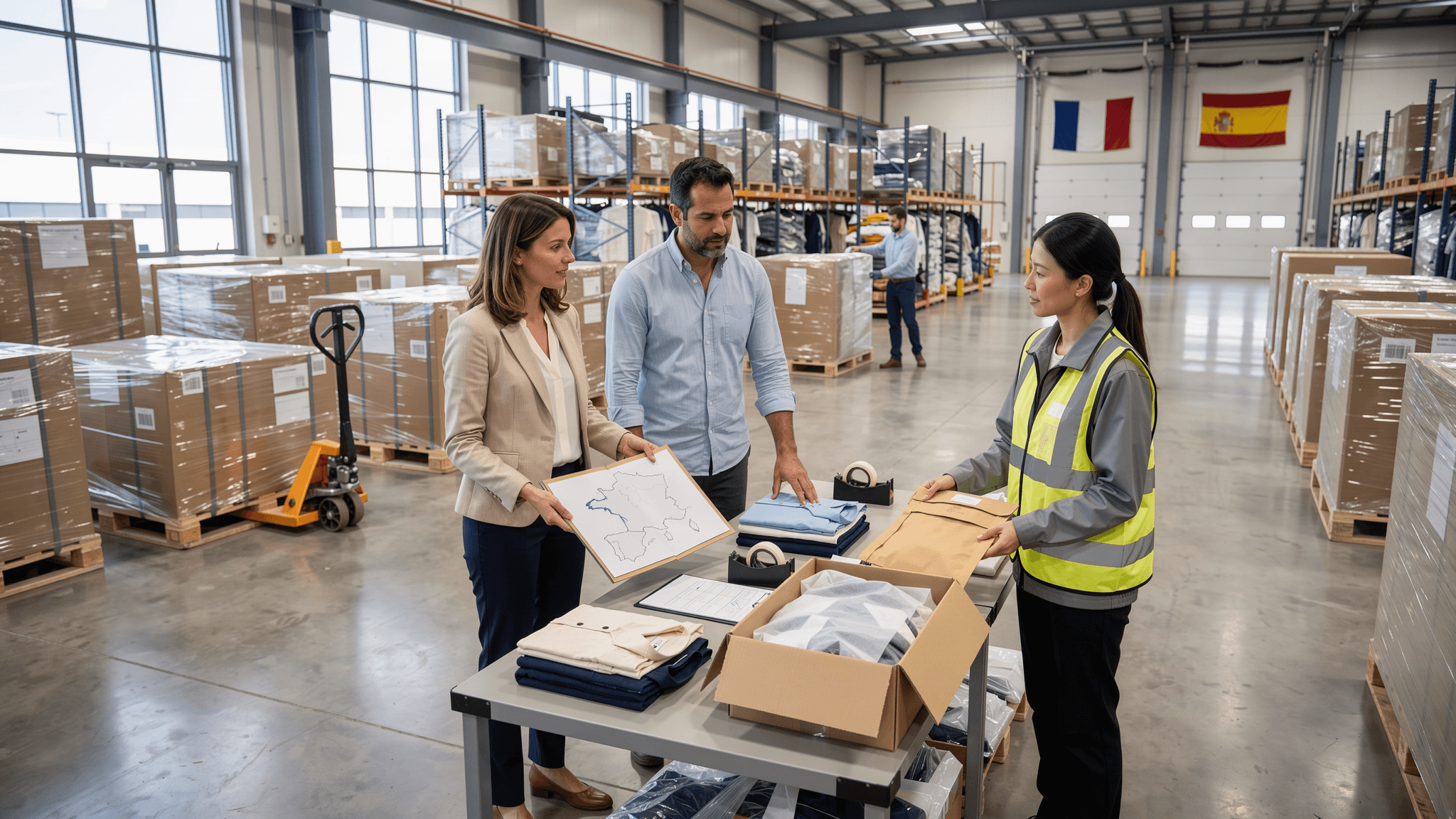
France and Spain look like obvious neighbours for a Polish or CEE apparel maker. Both are large, both are close by road, and both buy a lot of clothing and accessories. Yet many manufacturers send the same catalogue to both countries, wait for replies, and conclude that these markets are closed. They are not closed. They are simply two very different buying cultures, and apparel market entry in France and Spain needs a separate plan for each.
This article gives you a practical roadmap: where the real openings are, how to position your collection, which buyers to contact, and how to get meetings without relying only on trade fairs.
Why France and Spain Need Different Plans
In our view, French buyers care most about brand, quality, origin and sustainability, while Spanish buyers care most about volume, speed and flexibility. A buyer in Paris asks "what is the story behind this product?". A buyer in Madrid or Barcelona often asks "how fast can you deliver, and in what flexibility?".
If your export plan treats them as one "Southern Europe" block, you will dilute your message in both. Start by choosing which market fits your collection better today, then add the second one. Our framework for choosing which European market to export to first walks through that decision.
France: Escape the Middle of the Market
What the data says
Euromonitor's research on apparel and footwear in France describes a market that underperformed in 2025. The causes it names are market polarisation and a shift in consumer preferences towards affordability and sustainability.
For a manufacturer this has a blunt consequence. In our view, mid-range positioning, with no clear reason to pay more and no price advantage, is the riskiest place to be. Sportswear and sustainability-led products are, in our opinion, where a clear position is easiest to build.
💡 Key Insight: A French category buyer does not need another "good quality, fair price" supplier. They need a clear answer to one question: why should this product sit on my shelf next to the ones I already have?
How to position for French buyers
- Pick a side. Be clearly premium, clearly sustainability-led, or clearly sharp on price with a strong function (for example sportswear).
- Prove your claims. If you say recycled fibres, organic cotton or local production, add certificates and a short factory story to your line sheet.
- Lead with origin. If your products are made in Europe, make that visible in the first email.
- Write in French. A line sheet and first message in French signals commitment and gets read faster.
Spain: A Big Import Market Where Speed Beats Price
The size of the opportunity
Spain buys a great deal of clothing from abroad. According to Spain's apparel imports grew 7.10 per cent year on year to $19.014 billion during the first ten months of 2025, the market keeps importing even as sourcing patterns shift.
The same report shows how crowded the volume end is. Imports from China reached $3.637 billion, capturing a 19.13 per cent share, while Bangladesh followed closely at $3.597 billion with an 18.92 per cent share. In our view, that makes basic, high-volume lines very hard to win on price.
| Figure | What it means for a manufacturer | Source |
|---|---|---|
| Spain's apparel imports grew 7.10 per cent year on year to $19.014 billion during the first ten months of 2025 | Spain is a large and growing import market, so there is room for new foreign suppliers | Fibre2Fashion |
| Imports from China reached $3.637 billion, capturing a 19.13 per cent share, while Bangladesh followed closely at $3.597 billion with an 18.92 per cent share. | Two Asian suppliers dominate volume, so compete on speed, quality and flexibility instead | Fibre2Fashion |
Where European makers fit
For a Polish or CEE manufacturer, our view is that the opening in Spain is not price but proximity. A European maker can make a credible case on delivery speed, flexibility and small runs, which Asian volume suppliers find harder to match. For more background on the market, see the CBI analysis of the Spanish market potential for apparel.
⚡ Pro Tip: In your first message to a Spanish buyer, state your delivery time from order to warehouse and your minimum order quantity. Short delivery and small runs are your strongest arguments against Asian suppliers.
Who to Contact: Buyer Titles That Matter
Our advice is to start with the larger retail groups, because one buyer there can mean a large order. In France, also include department stores, specialist chains, online platforms and boutique groups in your buyer profile. In both countries, the people you want are:
- Category buyers and category managers at retail chains
- Purchasing directors at larger groups
- Import managers at importers and wholesalers
- Distributor owners who supply independent shops and regional chains
A general "info@" address rarely reaches any of them. A short, specific message to the right title, naming the product range and one clear benefit, performs far better than a long catalogue attachment.
Trade Fairs vs Direct Buyer Contact
Trade fairs still work for brand visibility, but the cost is high and the contact window is three days. A stand typically costs 15,000+ EUR for 3 days once you add the space, build, travel and staff time, and you meet whoever walks past.
| Trade fair stand | Contacting buyers directly | |
|---|---|---|
| Cost | 15,000+ EUR for 3 days | A fraction of the cost of a stand |
| Timing | Three days, once a year | Year-round |
| Who you meet | Whoever visits your stand | Buyers selected by your profile |
| Preparation | Stand, samples, travel | Line sheet, buyer profile, messages |
For many apparel makers the sensible approach is both: use direct buyer contact to open conversations all year, and use a fair to meet buyers you already know. For a wider view of how this compares with other routes, see our guide to entering export markets without opening a local office.
💡 Key Insight: Casper Morawski, founder of ProspectX, often tells manufacturers that the most expensive part of a trade fair is not the stand but the three days of hoping the right buyer walks by.
A Five-Step Roadmap
- Choose your first market. Pick France if your strength is premium, sustainable or sportswear. Pick Spain if your strength is speed, flexibility and short runs.
- Fix your positioning. Write one sentence explaining why a buyer should choose you over a mid-range competitor or an Asian volume supplier.
- Build two line sheets. One in French, one in Spanish, each with prices, minimum orders, delivery times and certificates.
- Define your buyer profile. Decide which retail types, countries, company sizes and exclusions apply, then list the buyer titles above.
- Contact buyers and follow up. Send short, specific messages, follow up within two weeks, and track which positioning gets replies.
For related buyer-contact examples in nearby regions, read our piece on retail buyers for apparel in Benelux and the Nordics.
From Our Experience
At ProspectX, we've seen this firsthand: apparel buyers respond to specifics, not to general introductions. For one apparel manufacturer, we have generated 100+ qualified buyer inquiries per month for over two years. The lesson we take from that work is that a clear buyer profile and a sharp message matter more than a large catalogue.
Our opinion is simple: most apparel exporters lose in France and Spain not because their product is weak, but because their message is generic. Fix that first.
Frequently Asked Questions
Which buyers should I contact in the French and Spanish markets?
Contact category buyers, category managers and purchasing directors at retail chains, plus import managers and distributor owners at importers and wholesalers, in both France and Spain. Start with the larger retail groups, because one buyer there can mean a large order. In France, then add specialist chains, department stores and boutique groups.
Is it better to enter France or Spain first?
Enter France first if your collection is premium, sustainability-led or sportswear, and Spain first if your advantage is speed, flexibility and short production runs. The two markets need separate line sheets and messages, so start with the one that fits your strengths and add the second afterwards.
Can a European manufacturer compete with China and Bangladesh in Spain?
Yes, but not on price. Imports from China reached $3.637 billion, capturing a 19.13 per cent share, while Bangladesh followed closely at $3.597 billion with an 18.92 per cent share, so basic volume is hard to win. In our view, European makers should compete on delivery speed, flexibility, quality and short supply chains.
Do I still need trade fairs to enter France and Spain?
No, trade fairs are not required, although they can help build visibility. A stand costs 15,000+ EUR for 3 days, so many manufacturers also contact buyers directly throughout the year and use fairs to meet buyers they already know.
Conclusion
Apparel market entry in France and Spain rewards manufacturers who choose a clear position, tailor their message to each market and speak to the right buyers. In France, avoid the mid-range. In Spain, compete on speed and quality rather than price. In both, contact category buyers, purchasing directors and import managers directly.
If you're a manufacturer looking to find foreign buyers without spending 15,000 EUR on trade fairs, ProspectX can help. Our pilot guarantees a minimum of 10 qualified meetings within 8-12 weeks for a fixed fee, with import managers, purchasing directors and distributors in your target markets. Book a free first call to discuss your export goals.
Part of the Export Market Entry guide.