Pitch Retail Buyers: UK & Nordics 2026
In short
To pitch retail buyers in the UK and Nordics in 2026, CEE manufacturers need to research each retailer's category structure, prepare a compliance-ready product file, and contact the right decision-maker directly with a concise, benefit-led introduction. Treat the UK and each Nordic country as separate markets with distinct requirements.
Key takeaways
- The UK and each Nordic country have distinct regulatory and consumer requirements, so a single pitch deck rarely works across all markets.
- Retail buyers in the UK and Nordics expect to see food safety certifications such as BRC or IFS before they will take a first meeting.
- Contacting a category manager or import manager directly, with a short and specific message, outperforms mass email every time.
- The UK grocery retail market reached USD 307.8 billion in 2026, meaning genuine shelf space is available for well-prepared CEE suppliers.
- ProspectX can deliver a minimum of 10 qualified meetings with import managers and category buyers within 8-12 weeks, for a fixed fee.
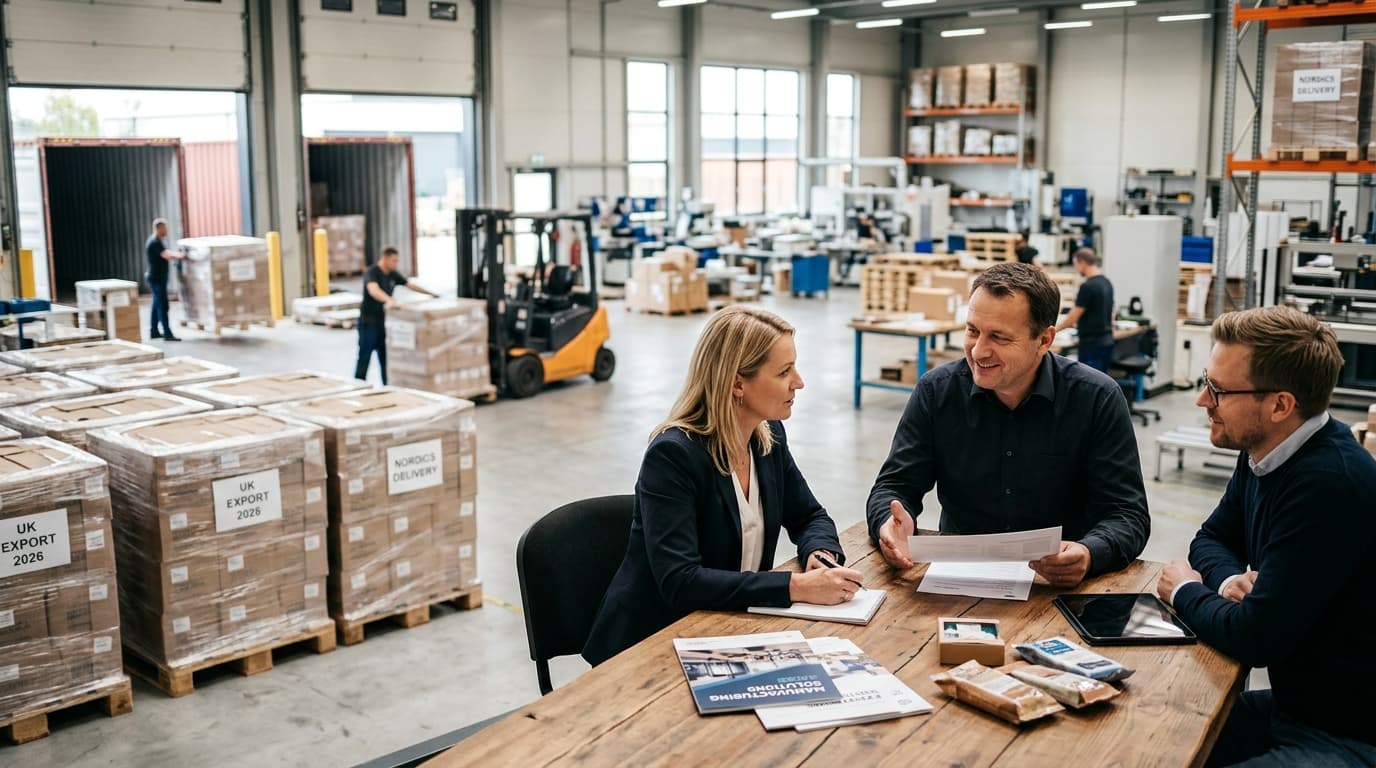
How CEE Manufacturers Can Pitch Directly to UK & Nordics Retail Buyers in 2026
Breaking into UK and Nordic retail as a CEE manufacturer has never been more achievable, and never more competitive. Retail buyers in London, Stockholm, Copenhagen and Helsinki are actively sourcing new suppliers, yet their inboxes are full of generic introductions that go nowhere. The manufacturers who win shelf space are the ones who arrive prepared: the right certifications, the right message, and the right contact.
The UK grocery retail market grew from USD 300.2 billion in 2025 to USD 307.8 billion in 2026, according to IMARC Group. That is a market large enough to absorb ambitious new suppliers, but only those who understand how buyers actually make purchasing decisions. The Nordic markets add further opportunity, with strong purchasing power and consumers who are increasingly comfortable buying from abroad.
This guide gives you a practical, step-by-step approach: how to identify the right buyers, what to prepare before you make contact, how to write a pitch that gets a response, and how to follow up without damaging the relationship.
Why 2026 Is a Pivotal Year for CEE Manufacturers
Several forces are converging to make 2026 an important year for CEE exporters. The UK has completed its post-Brexit regulatory separation from the EU. In our experience working with manufacturers entering the UK market, this means preparing for specific compliance steps: UKCA marking where relevant, UK-specific customs documentation, and product labelling that meets British standards rather than EU ones. This creates a higher barrier to entry, but also a genuine competitive advantage for manufacturers who clear it early.
At the same time, Nordic consumers are spending more. Based on what we observe when arranging meetings for manufacturers in the region, stabilising inflation and easing interest rates appear to have supported household purchasing power across Sweden, Denmark, Norway and Finland. And their appetite for foreign products is clear: about 8 out of 10 Nordic consumers made a purchase online from abroad in 2025, according to PostNord. That cross-border openness extends to physical retail, where category managers are under pressure to differentiate their ranges with products from new sources.
For CEE manufacturers in food, cosmetics, apparel and confectionery, the timing is good. But timing alone does not open doors. Preparation does.
💡 Key Insight: Nordic retail buyers do not treat their region as one market. A Swedish category manager at ICA has different supplier requirements than a Finnish buyer at Kesko. Prepare a country-specific approach for each.
Know the Market Before You Know the Buyer
The single most common mistake CEE manufacturers make when approaching UK or Nordic retail is treating either region as a single, uniform market. It is not.
In the UK, the major grocery chains (Tesco, Sainsbury's, Asda, Morrisons, Waitrose, Marks & Spencer and the discounters Aldi and Lidl) each have distinct supplier philosophies, margin expectations and category priorities. A product that fits Waitrose's premium positioning will not automatically suit Asda's value-driven buyer. Research each retailer's current range, identify the gaps your product could fill, and understand their private-label versus branded mix before you write a single word of your pitch.
In the Nordics, the big retail groups are ICA and Coop in Sweden, Salling Group and Coop in Denmark, NorgesGruppen and Rema 1000 in Norway, and S Group and Kesko in Finland. Each operates with its own category management structure and import requirements. Some work directly with foreign manufacturers; others prefer to source through a local importer or distributor. Researching a retailer's preferred sourcing model before you make contact will save you weeks of misdirected effort.
⚡ Pro Tip: Before contacting any buyer, spend one hour on the retailer's website. Look at the brands they already stock in your category. If they carry three Polish food brands, they are open to CEE suppliers. If they carry none, find out why before you pitch.
For a deeper look at how to reach the right people at Nordic retail chains, see our guide on how to reach import managers at Nordic retail chains in 2026.
Build Your Compliance and Certification File First
Retail buyers in the UK and Nordics will not take a meeting with a supplier who cannot demonstrate basic food safety compliance. This is not a formality; it is a filter. Category managers receive dozens of supplier enquiries each month. The first thing many of them check is whether you hold BRC Global Standards (now BRCGS) or IFS Food certification. Without one of these, your email is likely to be archived before it is read.
For the UK specifically, you will also need to consider:
- UKCA marking (for relevant product categories)
- UK-specific ingredient labelling (allergen declarations in English, using UK-approved terminology)
- Customs commodity codes for UK import
- A UK-based responsible person or importer of record, depending on your product category
For the Nordics, requirements vary by country, but common expectations include EU organic certification (if you are positioning the product as organic), country-of-origin labelling in the local language, and adherence to each country's food additive permitted lists, which can differ from the EU baseline.
Our detailed guide on certifications Nordic retail buyers require covers the specific documents buyers will ask for before a listing discussion begins.
📊 Retail eCommerce sales are predicted to reach 38.1% of the UK's total retail sales in 2025 (Source: International Trade Administration). Even if your target is physical shelf space, buyers will assess your packaging and product presentation with an online listing in mind.
How to Identify the Right Buyer Contact
Finding the right person is half the battle. Retail organisations are large, and sending your pitch to a generic enquiries inbox is rarely effective. You need a named individual: an import manager, a category buyer, or a category manager.
Here is a practical approach:
- Start with LinkedIn. Search for the retailer name combined with titles such as "category manager", "buying manager", "import manager" or "purchasing director". Filter by location (UK or the relevant Nordic country).
- Check industry directories. Trade associations such as the British Retail Consortium (BRC) and Nordic trade bodies publish member directories that sometimes include buyer contacts.
- Attend (or research) trade fairs. Events such as SIAL Paris, Anuga in Cologne, or the Speciality & Fine Food Fair in London are well-known industry gatherings where manufacturers and buyers meet. Even if you do not attend, exhibitor and visitor lists are sometimes available and give you names to research.
- Use your existing network. A Polish logistics partner or a local distributor in Sweden may already know the right buyer and can make a warm introduction.
Once you have a name, verify their current role. Roles in retail buying change frequently, and a contact who was category manager for ambient grocery six months ago may have moved to a different category or a different company.
| Market Statistic | What It Means for a CEE Manufacturer | Source |
|---|---|---|
| UK grocery retail market: USD 307.8 billion in 2026 | A large, active market with ongoing demand for new suppliers | IMARC Group |
| 8 out of 10 Nordic consumers bought online from abroad in 2025 | Nordic buyers are open to foreign products; cross-border credibility matters | PostNord |
| Retail eCommerce: 38.1% of UK total retail sales in 2025 | Buyers assess products for both physical and online listings | International Trade Administration |
| Mobile accounts for 72% of UK online retail in 2025 | Packaging and product images must look sharp on a small screen | IMARC Group |
Write a Pitch That Gets a Response
Once you have the right contact, your message needs to work hard. Retail buyers at major UK and Nordic chains are busy professionals managing large supplier bases, and the introductions that get a response are short, specific and immediately relevant.
A strong first message to a retail buyer follows this structure:
Line 1: Who you are and what you make. Be specific. "We manufacture premium rye crackers in Poland, certified to IFS Food standard, with a current export volume of X tonnes per year" tells a buyer more than "We are a leading food manufacturer."
Line 2: Why you are contacting this specific buyer. Show that you have done your research. "I noticed your ambient snacks range does not currently include a rye-based product from Central Europe" is far more compelling than a generic introduction.
Line 3: The commercial proposition. State your minimum order quantity, your price positioning (premium, mid-market, value), and your ability to supply the UK or Nordic market from stock or on a short delivery cycle.
Line 4: A clear, single ask. Do not ask for a listing. Ask for a 20-minute call to discuss whether there is a fit. Buyers are far more likely to agree to a conversation than to a commitment.
Attach a one-page product sheet (PDF, under 2MB) with a professional photograph, your certifications listed, and your key commercial terms. Do not attach a full catalogue on a first contact.
⚡ Pro Tip: When contacting a UK buyer, always reference your BRCGS or IFS certificate number in the first message. It signals professionalism and saves the buyer from having to ask.
For more on structuring your first message, see our guide on how to pitch retail buyers in the UK and Germany.
The Follow-Up: Persistence Without Pressure
Most positive responses from retail buyers do not come from the first message. They come from a well-timed follow-up. The challenge is following up in a way that adds value rather than simply repeating the original message.
A practical follow-up sequence:
- Day 1: Send your initial message.
- Day 8: Send a brief follow-up referencing a relevant piece of news (a trade show you are attending, a new certification you have received, or a market trend relevant to their category).
- Day 22: A final short message offering to send a product sample, no strings attached.
After three contacts with no response, pause for 60 days before trying again. Buyer priorities change. A category that was closed to new suppliers in January may be actively sourcing in March.
At ProspectX, we have seen this firsthand. When we arrange buyer meetings for manufacturers, the buyers who eventually convert often responded to a second or third contact rather than the first. Persistence, combined with relevance, is what separates manufacturers who get meetings from those who do not.
What ProspectX Does Differently
For many CEE manufacturers, the challenge is not knowing what to do. It is having the time and the local market knowledge to do it consistently, week after week, in a foreign language and a foreign market.
A trade fair stand at a major European food show costs 15,000 EUR or more for three days. You meet whoever walks past your stand, and then spend weeks following up with business cards from people who may or may not be decision-makers. It is expensive, exhausting and unpredictable.
Casper Morawski, founder of ProspectX, built the company specifically to solve this problem for manufacturers. Instead of waiting for buyers to find you at a trade fair, ProspectX contacts import managers, purchasing directors and category buyers on your behalf, qualifies their interest, and delivers ready-made meetings directly to your calendar.
For one apparel manufacturer, ProspectX generated 100 or more qualified buyer inquiries per month for over two years. Our pilot guarantees a minimum of 10 qualified meetings within 8-12 weeks, for a fixed fee, a fraction of what a 15,000 EUR trade fair stand costs.
The manufacturer provides the buyer profile and any company exclusions. ProspectX selects the companies and contacts the right individuals. Message content is approved by the client before any contact is made.
You can read more about how ProspectX works or see manufacturers we have worked with.
Frequently Asked Questions
How do I find the name of the right buyer at a UK or Nordic retailer?
LinkedIn is the most reliable starting point: search the retailer's name combined with titles such as "category manager", "import manager" or "purchasing director", filtered by country. Industry trade directories and trade fair visitor lists are also useful. Always verify that the person is still in the role before making contact, as roles in retail buying change frequently.
What certifications do UK retail buyers require from foreign food manufacturers?
Most major UK retailers require BRCGS (formerly BRC) or IFS Food certification as a baseline condition for listing discussions. Some premium retailers also ask for organic, Fairtrade or Rainforest Alliance certification depending on the category. You will also need UK-compliant labelling and, in some categories, UKCA marking. Our guide on certifications Nordic retail buyers require covers the equivalent requirements for the Nordics.
Should I approach Nordic retail buyers as a single region or country by country?
Country by country is the right approach. Sweden, Denmark, Norway and Finland each have distinct retail structures, dominant retail groups, consumer preferences and regulatory requirements. A pitch tailored to a Swedish ICA buyer will not automatically resonate with a Finnish Kesko buyer. Treating the Nordics as one market is one of the most common and costly mistakes CEE manufacturers make.
How long does it typically take to get a first meeting with a UK or Nordic retail buyer?
Expect the process to take several weeks from first contact to a confirmed meeting, assuming your product is a genuine fit for the retailer's range and your compliance documentation is in order. Buyers are busy and their response times vary. A structured follow-up sequence over three to four weeks gives you the best chance of a response. ProspectX's pilot guarantees a minimum of 10 qualified meetings within 8-12 weeks.
Is a trade fair the best way to meet UK and Nordic retail buyers?
Trade fairs can be useful for building brand awareness and meeting buyers who are actively sourcing, but they are expensive (a stand at a major European food show costs 15,000 EUR or more) and unpredictable. You have no control over who visits your stand. Contacting buyers directly, with a targeted and well-prepared approach, gives you more control over who you meet and when.
Conclusion
Pitching retail buyers in the UK and Nordics in 2026 is a process, not a single event. It starts with market research, moves through compliance preparation, and requires a targeted, well-written approach to the right individual at the right retailer. The manufacturers who succeed are those who treat each market as distinct, invest in the right certifications, and follow up with patience and relevance.
The UK grocery market at USD 307.8 billion and the Nordic markets with their internationally minded consumers represent real opportunities for CEE manufacturers with quality products and the discipline to approach buyers professionally.
If you are a manufacturer looking to find foreign buyers without spending 15,000 EUR on trade fairs, ProspectX can help. We deliver ready-made meetings with import managers, purchasing directors, and distributors in your target markets. Book a free first call to discuss your export goals.