Contact Retail Buyers: DACH & Nordics
In short
To contact retail buyers in DACH and Nordics, manufacturers should send short, personalised messages in the buyer's native language, referencing their specific category needs. DACH buyers expect formal documentation and patience; Nordic buyers value directness. Both regions require certification proof, relevant product data, and consistent follow-up to build trust before a listing conversation begins.
Key takeaways
- DACH and Nordic retail buyers expect personalised, native-language communication that demonstrates genuine knowledge of their category and market before they will agree to a meeting.
- German and Austrian buyers require formal documentation and a patient approach, while Swedish, Danish, and Norwegian buyers tend to favour directness and shorter decision paths.
- Certifications such as IFS or BRC/BRCGS are often a prerequisite for any retail listing conversation in both DACH and Nordic markets, so prepare them before contacting buyers.
- Trade fairs remain a legitimate entry point in DACH, but they cost 15,000+ EUR for a stand and deliver only three days of contact, making year-round buyer contact a more cost-effective strategy.
- ProspectX guarantees a minimum of 10 qualified meetings with import managers, purchasing directors, and category buyers within 8-12 weeks, for a fixed fee.
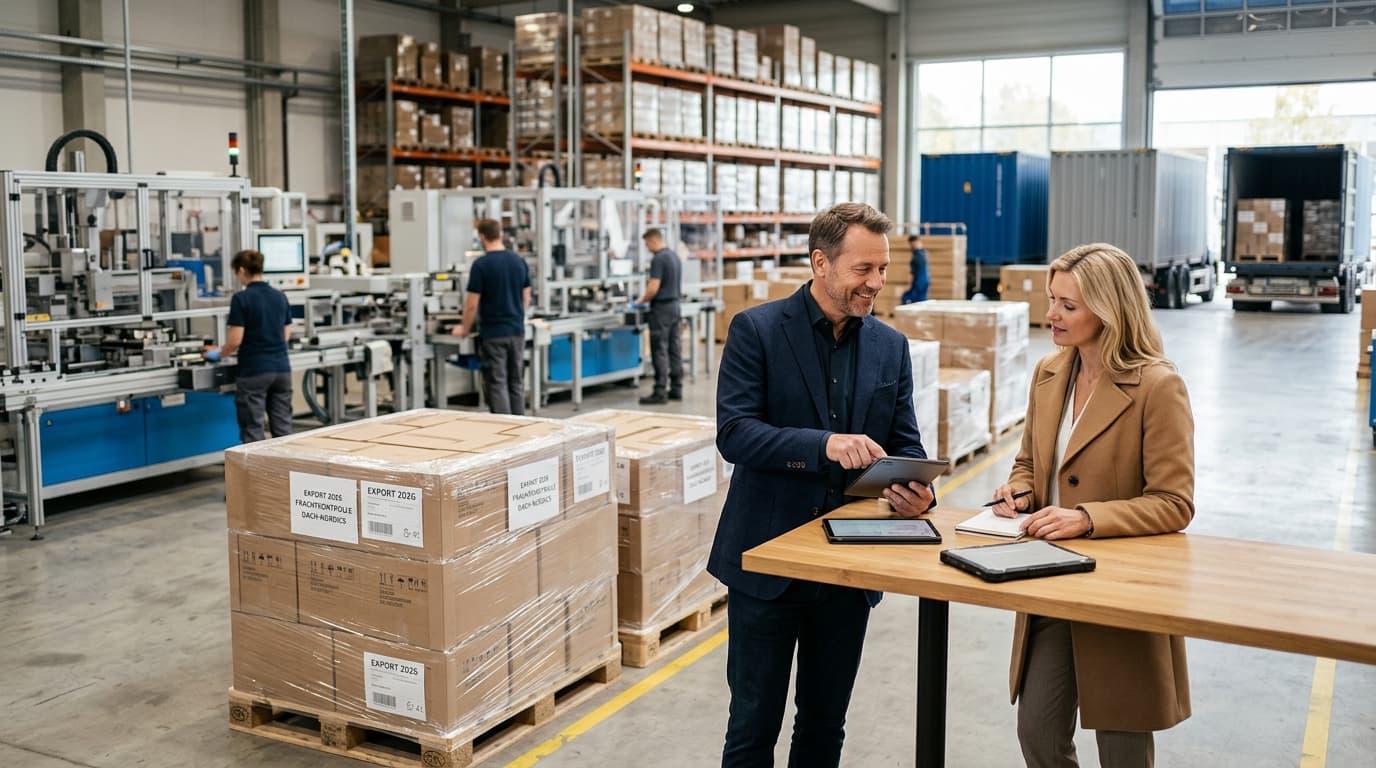
How to Contact Retail Buyers in DACH and Nordics as a Manufacturer
58% of European manufacturers expect their business to grow in 2026, and most of them are eyeing the same two regions: DACH (Germany, Austria, Switzerland) and the Nordics (Sweden, Denmark, Norway, Finland). The demand is real. Retail sales across the euro area rose 0.8% year-on-year in August 2026, and Germany's exports reached 817.8 billion euros in the first half of 2026 alone, signalling a trading environment that rewards well-prepared suppliers.
But knowing there is demand and actually getting in front of a category buyer at Rewe, Edeka, ICA, or Coop are two very different things. Most manufacturers either rely on expensive trade fair stands or send generic emails that never get a reply. This article explains how to contact retail buyers in DACH and Nordics in a way that gets results: the right channels, the right tone, and the right timing.
Why DACH and Nordic Retail Buyers Are Worth the Effort
The DACH region is the largest consumer market in continental Europe. Germany alone has a retail grocery sector dominated by powerful chains with centralised buying functions. Austria and Switzerland add further volume, though each has its own regulatory framework, VAT rules, and buyer culture. For a Polish or CEE manufacturer, breaking into even one DACH retailer can transform annual revenue.
The Nordics are smaller by population but punch above their weight in per-capita spending, particularly on food, cosmetics, and apparel. Swedish, Danish, and Norwegian retailers are often early adopters of new product categories, making the region a strong proving ground before a wider European rollout. The challenge is that Nordic buyers are busy professionals who receive a high volume of supplier approaches every month, so standing out requires more than a product catalogue.
📊 B2B transactions dominate the European e-commerce market at 78.05% in 2025, with the overall market valued at USD 4.29 Trillion. This signals that digital-first buyer contact is no longer optional for manufacturers seeking retail listings. (Source: IMARC Group)
Understanding the Buyer You Are Contacting
Before you contact retail buyers in DACH and Nordics, you need to know exactly who makes the decision. In a large retail chain, the relevant person is usually a category manager or category buyer, sometimes called a purchasing director or import manager. They are responsible for a specific product category, such as ambient food, chilled, personal care, or textiles, and they receive supplier proposals constantly.
In DACH chains, buying decisions often involve multiple stakeholders: the category manager, a quality assurance contact, and sometimes a regional buying committee. Expect a longer process. In Nordic chains, the category buyer often has more individual authority, and decisions can move faster once trust is established.
⚡ Pro Tip: Before contacting a German category manager, identify which sub-category they manage. A buyer responsible for ambient sauces is not the right contact for chilled dairy. Getting this wrong signals a lack of preparation and your message will be ignored.
For manufacturers exploring the Swedish market specifically, our Food Importers and Distributors in Sweden guide covers the key buyer types and what they expect from new suppliers.
How to Contact Retail Buyers in DACH: Region-Specific Approach
Germany, Austria, and Switzerland share a language but not a buying culture. German retail buyers at chains such as Edeka, Rewe, Lidl, or Aldi expect formality, precision, and patience. A first message should be concise but include enough product detail to be taken seriously: your product category, your certifications (IFS or BRCGS are near-mandatory), your production capacity, and a clear statement of why your product fits their current range.
Email is the standard first contact channel in DACH. Cold calling exists as an option, but in our experience working with manufacturers approaching German and Austrian buyers, email followed by a polite follow-up call is the safer and more widely accepted sequence. Write in German. A message in English signals that you have not committed to the market, and most category managers will not translate your pitch for you.
💡 Key Insight: German retail buyers are thorough. They will research your company before responding. Make sure your website has a German-language page, your certifications are current, and your product specifications are available as a PDF before you send the first message.
For a deeper look at what DACH buyers require before they will list a product, see our article on what DACH retail buyers require before they list you.
Austria and Switzerland follow similar patterns, but each has its own retailer landscape (SPAR dominates Austria; Migros and Coop dominate Switzerland) and its own import regulations. Do not treat them as identical to Germany.
How to Contact Retail Buyers in Nordics: Region-Specific Approach
Nordic buyers are generally more direct and less hierarchical than their DACH counterparts. A well-researched, short email in Swedish, Danish, or Norwegian (depending on the country) that gets to the point quickly will outperform a long formal proposal. Nordic category managers respect suppliers who have done their homework: know the retailer's current range, identify a gap your product fills, and say so in the first two sentences.
LinkedIn is a genuinely effective channel in the Nordics. Many category buyers at ICA, Coop, Rema 1000, or Kesko have active profiles and respond to personalised connection requests from credible suppliers. The key word is personalised: a generic connection request with no message will be ignored. Reference a specific product category, a recent range update, or a trade show you both attended.
⚡ Pro Tip: When contacting a Swedish category buyer on LinkedIn, check their profile for any recent posts about category trends or new listings. Referencing something specific they have shared shows genuine interest and dramatically improves your response rate.
For manufacturers in the apparel and accessories sector, our guide on retail buyers for apparel in Benelux and Nordics covers the specific buyer expectations in those categories.
One important note: Nordic buyers move faster once engaged, but they also disengage quickly if follow-up is slow or generic. Respond to any reply within 24 hours and have your product samples, pricing, and certification documents ready to send immediately.
Certifications: The Non-Negotiable First Step
In both DACH and Nordics, your certification status is often checked before a buyer will even open your product catalogue. IFS Food or BRC/BRCGS certification is expected for food and beverage manufacturers. For cosmetics, ISO 22716 (GMP) is standard. For apparel, sustainability certifications such as GOTS or OEKO-TEX are increasingly required by Nordic buyers.
If you do not have the relevant certification, most retail buyers will not engage. This is not a negotiating point; it is a gate. Invest in certification before you begin contacting buyers, not after.
Our detailed guides on certifications Nordic retail buyers require and IFS vs BRCGS for German retail buyers explain exactly which documents to prepare for each market.
Trade Fairs vs. Year-Round Buyer Contact: A Practical Comparison
Many manufacturers default to trade fairs as their primary method of contacting retail buyers in DACH and Nordics. Anuga, SIAL, Biofach, and Coop Forum are all legitimate venues where buyers do attend. But a trade fair stand costs 15,000+ EUR for three days, requires months of preparation, and delivers a limited number of conversations, many with visitors who are not decision-makers.
📊 The Eurozone Manufacturing PMI rose to 52.9 in September 2026, indicating expanding production activity. More manufacturers competing for the same buyer attention makes standing out at a trade fair harder than ever. (Source: S&P Global / Trading Economics)
The table below compares the two approaches across the dimensions that matter most to a manufacturer planning market entry.
| Dimension | Trade Fair Stand | Year-Round Buyer Contact (ProspectX) |
|---|---|---|
| Cost | 15,000+ EUR per event | Fixed fee |
| Duration of access | 3 days | 8-12 weeks (pilot) |
| Buyer quality | Mixed (not all are decision-makers) | Qualified: import managers, category buyers, purchasing directors |
| Geographic reach | Visitors who travel to the fair | DACH, Nordics, Benelux, UK |
| Meetings guaranteed | No | Minimum 10 qualified meetings |
| Language/localisation | Your responsibility | Handled as part of the programme |
| Preparation time | 3-6 months | Weeks |
At ProspectX, we see this contrast clearly when manufacturers come to us after a trade fair where they spent well over the cost of a stand and left with a handful of business cards but no confirmed meetings with category buyers. A year-round approach to contacting buyers, tailored to each region's communication norms, consistently delivers more qualified conversations for a fraction of the cost.
What a Good First Message to a Retail Buyer Looks Like
Whether you are emailing a German purchasing director or messaging a Swedish category manager on LinkedIn, the structure of a strong first message is similar.
- Open with relevance: Name the specific category you supply and reference something specific about their range or a market trend they are likely tracking.
- State your credentials: Your certifications, your production capacity, and one or two key markets where you already supply retail.
- Make a specific ask: Request a 20-minute call or video meeting, not a general expression of interest. Give two or three specific dates.
- Keep it short: Six to eight sentences maximum. Buyers do not read long introductory emails.
- Follow up once: If you receive no reply after seven to ten days, one polite follow-up is appropriate. More than that damages your credibility.
Casper Morawski, founder of ProspectX, notes that the most common mistake manufacturers make is sending the same message to every buyer. A category manager at a German discounter and a category buyer at a premium Swedish grocery chain have completely different priorities. Treating them identically signals that you do not understand either market.
For a practical walkthrough of the full process of contacting DACH importers, see our 2026 playbook for contacting DACH importers.
Key Data: European Trade and Retail Context for 2026
| Figure | What it means for a manufacturer | Source |
|---|---|---|
| 58% of European manufacturers expect growth in 2026 | Competition for buyer attention is increasing; differentiation matters more than ever | ECI Solutions |
| EU exports and imports valued at 9,358,835.4 million EUR in 2025 | Cross-border trade is at a record high, creating real buyer demand for new suppliers | Eurostat via IndexBox |
| Retail sales index up 0.8% in euro area, August 2026 vs August 2025 | Retail buyers are under pressure to refresh ranges as consumer spending grows | Eurostat / European Commission |
| B2B segment is 78.05% of European e-commerce in 2025 | Digital buyer contact is the dominant channel; manufacturers who ignore it lose ground | IMARC Group |
| Eurozone Manufacturing PMI at 52.9, September 2026 | Production is expanding, meaning more suppliers are chasing the same buyers | S&P Global / Trading Economics |
Frequently Asked Questions
How long does it take to get a meeting with a category buyer in the Nordics?
For most manufacturers approaching Nordic retail buyers without an existing relationship, securing a first meeting typically takes four to eight weeks from initial contact. Nordic buyers respond relatively quickly compared to DACH, but they still need time to review your product, check your certifications, and align with internal schedules. Having your samples, pricing, and documentation ready to send immediately after a positive first reply shortens this window significantly. ProspectX's pilot programme guarantees a minimum of 10 qualified meetings within 8-12 weeks across your target markets.
What is the best channel to contact a German retail buyer?
Email is the standard first-contact channel for German retail buyers, followed by a polite phone call if there is no reply after seven to ten days. Write in German, keep the message concise, and include your IFS or BRCGS certification reference in the first email. LinkedIn is growing in use but is less dominant in DACH than in the Nordics.
Do I need to speak the local language to contact retail buyers in DACH and Nordics?
For DACH, communicating in German is strongly recommended and, in practice, close to essential. German and Austrian buyers rarely engage with English-only suppliers at the initial contact stage. For the Nordics, English is more widely accepted, particularly in Sweden and Denmark, but a message in the buyer's native language will always outperform one in English.
What certifications do I need before contacting retail buyers in these regions?
For food and beverage manufacturers, IFS Food or BRC/BRCGS certification is expected by most DACH and Nordic retail buyers before they will consider a listing. For cosmetics, ISO 22716 is standard. Nordic buyers also increasingly require sustainability credentials such as GOTS or OEKO-TEX for apparel. Contacting buyers without the relevant certification is unlikely to result in a meeting.
Is it worth attending trade fairs to meet DACH and Nordic retail buyers?
Trade fairs such as Anuga or Biofach can be worthwhile if you pre-book meetings with specific buyers before the event, rather than relying on stand traffic. However, a stand costs 15,000+ EUR for three days and does not guarantee meetings with the right decision-makers. Year-round buyer contact is a more cost-effective complement or alternative, particularly for manufacturers who cannot afford to attend multiple fairs each year.
Conclusion
Knowing how to contact retail buyers in DACH and Nordics is one of the most valuable skills a manufacturer can develop in 2026. The opportunity is real: retail sales are growing, cross-border trade is at record levels, and buyers in both regions are actively looking for new suppliers. But the approach matters enormously. German buyers want formality, documentation, and patience. Nordic buyers want directness, brevity, and native-language communication. Both want certified, credible suppliers who understand their category.
If you are a manufacturer looking to find foreign buyers without spending 15,000+ EUR on trade fairs, ProspectX can help. We deliver ready-made meetings with import managers, purchasing directors, and category buyers in DACH, Nordics, Benelux, and the UK. Book a free first call to discuss your export goals.